
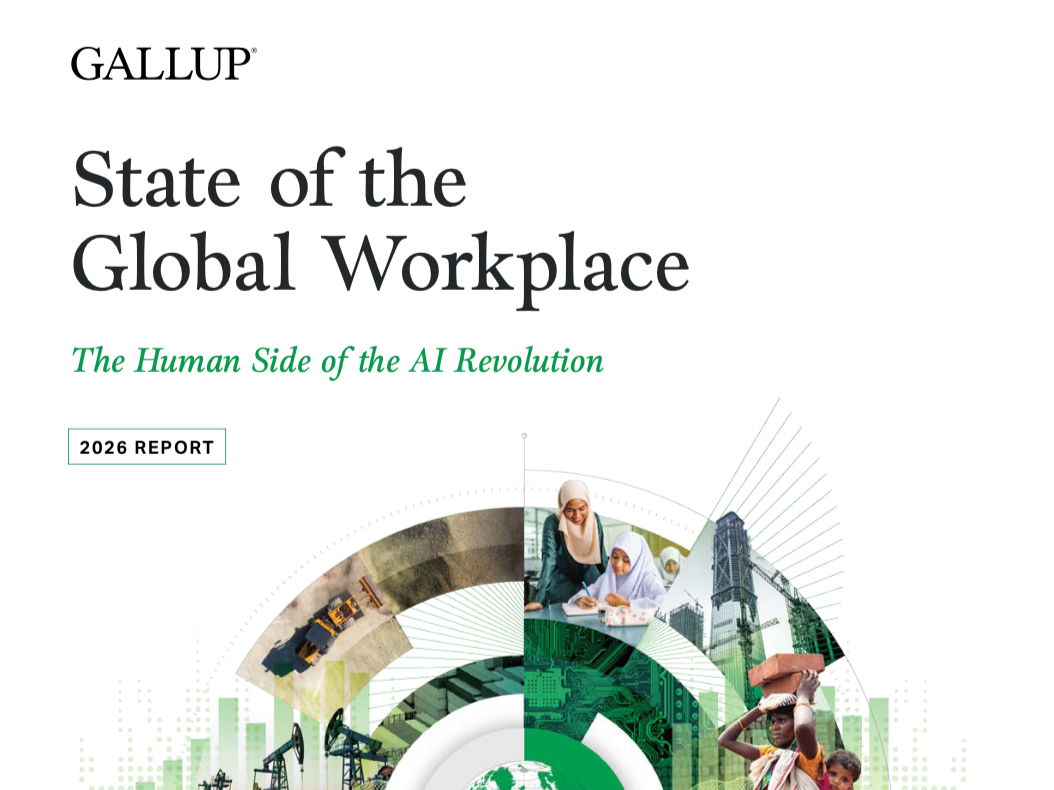
Gallup's State of the Global Workplace is one of the most widely recognised reports on employee engagement, workplace wellbeing and organisational performance.
The 2026 report paints a clear picture of the challenges facing employers today, from declining employee engagement and increasing pressure on managers to the opportunities and uncertainty created by AI.
Whilst the report covers hundreds of pages of global data, we've highlighted the five findings we believe are most relevant for employers and HR leaders, together with what they mean in practice.
1. Employee engagement continues to decline
For the second consecutive year, global employee engagement has fallen, with just 20% of employees now classed as engaged at work. Gallup estimates this costs the global economy around $10 trillion in lost productivity each year.
Engagement isn't simply about whether people enjoy their job. It reflects the extent to which employees feel connected to their work, committed to their organisation and motivated to contribute.
For employers, declining engagement isn't just an HR metric. It affects productivity, retention, collaboration and an organisation's ability to adapt during periods of change.
2. Managers have become the pressure point
One of the report's most significant findings is that declining manager engagement accounts for much of the overall fall in employee engagement.

Managers are being asked to lead through increasing workloads, organisational change, hybrid working, employee wellbeing concerns and now AI adoption.
Yet many still receive relatively little development in the practical skills required to lead people effectively.
Communication, emotional intelligence, psychological safety, resilience and coaching aren't simply leadership qualities. They're learned capabilities that increasingly determine how well teams perform.

3. AI won’t deliver results without people
Artificial intelligence features prominently throughout this year's report.
However, one of Gallup's strongest messages is that technology alone isn't improving organisational performance. Many organisations have yet to see measurable productivity gains because the limiting factor is no longer the technology itself, but organisational readiness and management capability.
AI can undoubtedly improve efficiency, but it cannot replace good judgement, effective communication, trust or strong leadership.
As organisations continue to invest in technology, they must invest equally in the human skills that enable people to work together effectively.
4. Wellbeing is improving, but pressure remains high
There is some encouraging news. Employee wellbeing improved slightly for the first time in three years. However, levels of stress, anger and sadness remain well above pre-pandemic levels. This suggests organisations should think beyond standalone wellbeing initiatives.
Creating healthier workplaces means equipping managers to have better conversations, fostering psychologically safe teams and helping people perform sustainably under pressure.
5. Human skills are becoming a business capability
If there is one theme running throughout the report, it is this:
Organisations won't thrive simply because they adopt new technology.
They will thrive because they develop managers and leaders who can communicate clearly, build trust, support wellbeing, navigate uncertainty and lead teams through change.
Increasingly, these aren't "soft skills". They're business-critical capabilities.
Final thoughts
The State of the Global Workplace 2026 report reinforces something we've believed for a long time: organisational performance depends as much on people as it does on processes and technology.
As workplaces continue to evolve, investing in manager capability, leadership development and the human skills that underpin high-performing teams is likely to become one of the most important decisions organisations make.
You can download the report in full here.
Looking to build a healthier, higher-performing workplace?
We work with organisations to develop practical skills in leadership, communication, resilience, psychological safety and workplace wellbeing through evidence-informed workshops and development programmes. Get in touch to discuss your organisation's priorities.